
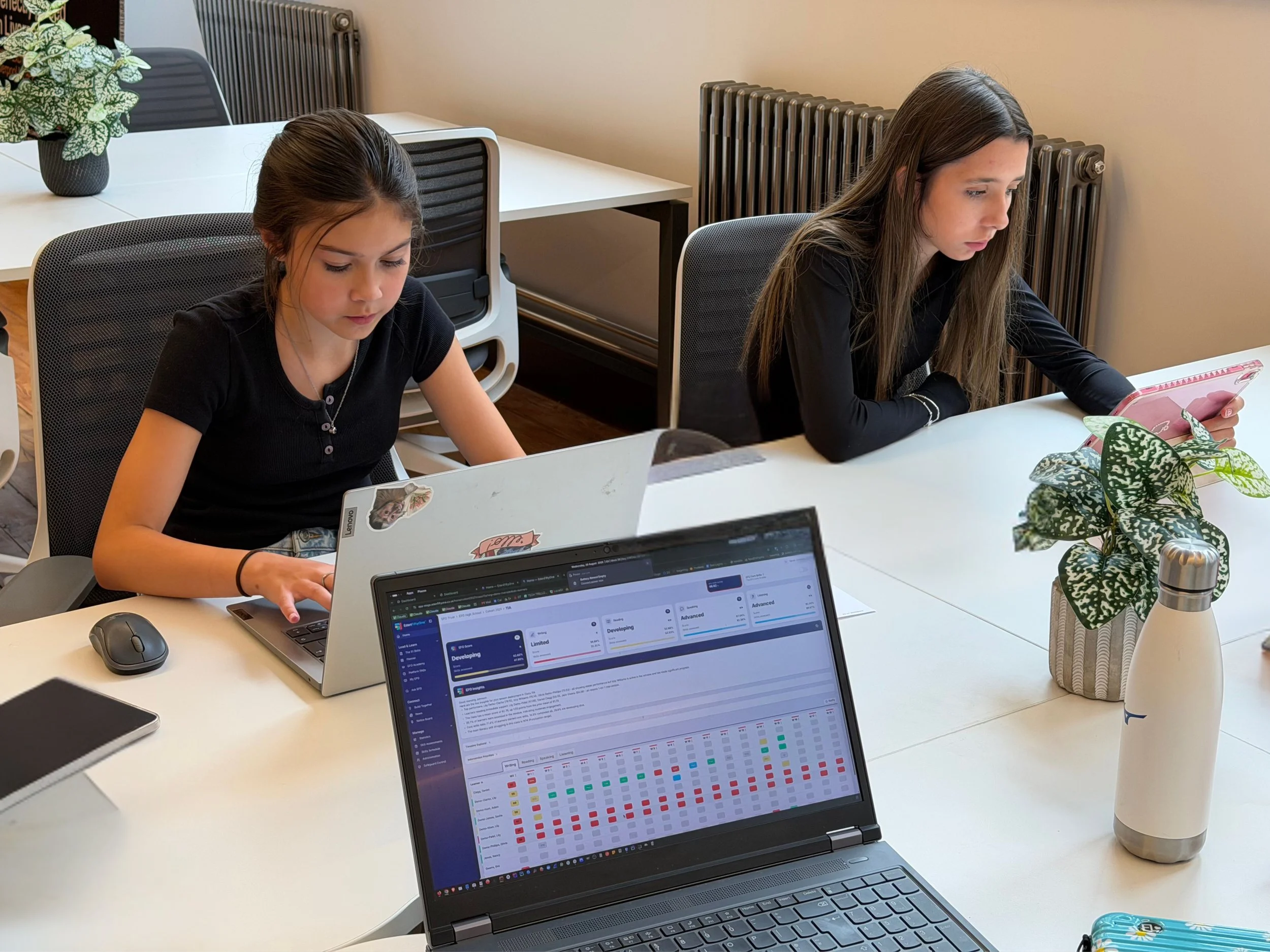
When former Liverpool English teacher, Tom Reynolds, started questioning how literacy was taught in secondary schools, he had no intention of creating an education technology company. He simply wanted to find a better way of helping his students. Over twenty years later, that idea has become EdenFiftyOne, an award-winning literacy platform built around the needs of teachers and the young people they teach.
Ahead of BRILLIANT Festival on 10th November, we spoke to Tom about the experiences that shaped EdenFiftyOne, why he believes education has become too distracted by technology and what needs to change if we're serious about improving literacy.
It started with a question
Tom Reynolds knows the pressures facing English teachers because he's spent much of his working life experiencing them.
A five-time Head of English and former Assistant Headteacher at Childwall Sports and Science Academy, he's worked in schools across Liverpool and Knowsley, supported English departments nationally and now works with trainee teachers at Liverpool John Moores University.
Throughout that time, one particular frustration kept coming back to him.
Secondary English teachers are expected to teach increasingly complex literature while many of their students are still struggling with the fundamentals of written language.
A student might be studying Macbeth or analysing poetry for their GCSEs but still lack the confidence to construct a sentence, organise a paragraph or use punctuation accurately.
It's a difficult position for teachers, who are working towards demanding examination outcomes while trying to address gaps in learning that may have developed years earlier.
"The secondary system relies on a fantasy: that a child's Year 6 literacy mechanics will magically survive puberty and carry them – five years later – through GCSE English and the wider curriculum. The system forces English teachers to spend their careers icing unbaked cakes."
For Tom, the problem wasn't a lack of commitment from teachers. It was the assumption that foundational literacy skills, once taught, would somehow remain securely in place without further attention.
He began to wonder whether there was a more effective way to identify those skills and help students develop them throughout secondary education and beyond.
The question was personal, too.
Making sense of English
Tom was diagnosed with dyslexia at 21, just four days after completing his English degree.
He remembers English feeling like a "gaseous cloud", something difficult to grasp despite his obvious passion for the subject.
That experience gave him a particular interest in how students understand their own learning and why some find the mechanics of writing so difficult.
Early in his teaching career, he asked his Head of Department how many foundational skills actually existed beneath the different texts, qualifications and examination specifications.
The answer was simply "lots". While this answer wasn't particularly helpful, it gave Tom something to work on.
He started breaking down the skills students needed to become confident readers, writers, speakers and listeners, looking beyond individual exam questions to the abilities that could be taught and developed over time.
His first solution was a colour-coded Excel spreadsheet.
It wasn't especially sophisticated, but it allowed him to map students' progress against specific formative literacy skills rather than relying entirely on summative - and frankly, unhelpful - examination grades.
He could see what students understood, where they were struggling and what they needed to work on next.
"Summative grades tell you where a student ended up, not about the learning journey that led them there. Grades don't help students to learn, teachers to teach, leaders to lead, or parents to support. Everyone benefits from diagnostic clarity. No one benefits from summative ambiguity."
What began as a way to make his own teaching more effective gradually developed into something much bigger.
Nine years in the making
That original spreadsheet eventually became EdenFiftyOne, a Liverpool-based education technology company focused on foundational literacy, but while the technology has changed considerably, the thinking behind it hasn't.
Tom is wary of the suggestion that artificial intelligence will somehow solve education's most persistent challenges.
"Technology is not a solution in itself. Big Tech wants you to believe AI will swoop in and magically fix education. It won't. AI is merely the vehicle we need to democratise proven foundational pedagogy."
It's an important distinction.
EdenFiftyOne hasn't been developed around what technology can do. It's been developed around what teachers need it to do.
Its literacy skills assistant, known as EFO, has evolved through nine years of work with educators in different settings across the UK.
That includes collaboration with SEND and SEMH specialists, further education colleges and schools supporting students working towards very different GCSE outcomes.
The latest version, EFO V6, brings together that experience in a platform designed to teach, assess and track the foundational skills that underpin literacy.
The idea is to give students more opportunities to practise the mechanics of reading and writing while reducing the amount of repetitive work falling to English teachers.
Tom has a useful way of describing it.
If language and literature are the sheet music, literacy skills are the scales on the English piano.
Teachers want to spend their time exploring the language and the literature they love with students, but that becomes much harder when they're constantly having to revisit the basics.
EFO is intended to support that essential practice so students arrive in lessons better prepared to engage with and enjoy the subject itself.
It's not about taking the teacher out of teaching. Quite the opposite.
Why Liverpool matters
Although EdenFiftyOne now works with educators across the country, its connection to Liverpool remains important.
Tom's experience in local schools helped shape the original idea, and the company's development has been informed by the challenges faced by teachers working in real classrooms.
Its headquarters are in Liverpool, and Tom continues to contribute to teacher education locally through his work with Liverpool John Moores University.
There's something fitting about a company challenging established approaches to education being based in a city with a long history of doing things its own way.
EdenFiftyOne didn't emerge from a technology company looking for a place in the education market. It came from a teacher trying to solve a problem he understood first-hand.
That difference continues to influence how the platform is developed and the people involved in shaping it.
It's also why the team is looking forward to being part of BRILLIANT Festival, which returns to Exhibition Centre Liverpool on 10th November.
Bringing EdenFiftyOne to BRILLIANT
EdenFiftyOne will be involved in several parts of this year's festival, including sponsoring the Secondary Innovation in Learning Award.
The award celebrates approaches that are making a difference to secondary education, something particularly close to Tom's heart given his own journey from the classroom into educational innovation.
Tom will also be joining the From Classroom to Career panel in the Imagine Theatre at 12:40pm, discussing how education and industry can work more closely together to support young people's futures.
Throughout the day, the EdenFiftyOne team will be exhibiting their latest platform, EFO V6, and introducing Core Mode, a streamlined ‘intervention version’ focused on the 14 universal reading and writing skills at the heart of GCSE English success. You can find them at D5 for a free demonstration.
Visitors will be able to see the technology in action, speak directly to the team and enter a draw to win a fully funded Literacy Skills Intervention Programme for their school or college.
Getting back to what matters
There's a lot of excitement about what technology might make possible in education over the coming years.
Some of that excitement is justified but Tom's story is a reminder that before asking what new technology can do, it's worth asking what problem we're actually trying to solve.
For EdenFiftyOne, that question has remained the same since the days of Tom's first spreadsheet.
How can we make it easier for students to develop the literacy skills they need, without placing even more pressure on the teachers supporting them?
It's taken nine years to develop the answer, and, like the best teachers, they’re still learning..
What started in a Liverpool classroom will be on show at BRILLIANT this November, alongside educators and organisations who share the ambition to make education better.
Meet Tom Reynolds and the EdenFiftyOne team at BRILLIANT Festival on Tuesday 10th November at Exhibition Centre Liverpool.
Find out more about EdenFiftyOne at edenfiftyone.com